
ADA/EUR: Price Drivers, Charts, Fees, and Pro Tips to Trade Cardano in Euro
Table of Contents
- What Is the ADA/EUR Pair?
- Why Trade ADA/EUR Instead of ADA/USD?
- How to Read ADA/EUR Price Charts
- Key Drivers That Move ADA/EUR
- Fees, Spreads, and Liquidity on ADA/EUR
- Trading Strategies for ADA/EUR
- Risk Management for ADA/EUR Volatility
- On-Chain and Macro Indicators to Watch
- How to Buy ADA with EUR: Step-by-Step
- Taxes, Regulation, and Storage for ADA/EUR Traders
What Is the ADA/EUR Pair?
ADA/EUR is the trading pair that quotes the price of Cardano’s native token (ADA) in euros (EUR). In simple terms, it shows how many euros you need to buy one ADA. If ADA/EUR is 0.45, a single ADA costs €0.45. This quote matters for eurozone traders, investors, and businesses who fund accounts in EUR and want direct exposure to Cardano without converting through USD.
Explore a convenient crypto purchase option at https://changehero.io/buy/btc where you can complete transactions quickly while benefiting from clear pricing and a streamlined process.
Cardano is a proof-of-stake blockchain focused on security, scalability, and formal verification. As adoption expands across decentralized finance (DeFi), governance, and real-world tokenization, demand for ADA can change quickly. The ADA/EUR rate reflects both crypto market dynamics and euro-specific macro trends, making it a unique lens into crypto–fiat interplay in Europe.
Unlike stablecoin pairs (e.g., ADA/USDT), ADA/EUR connects directly to the European banking system via SEPA transfers, EUR cards, and local payment rails. That often simplifies deposits, withdrawals, and accounting for EU residents. For traders, ADA/EUR can also offer tighter spreads during European session hours and a clearer read on euro-denominated risk.
Why Trade ADA/EUR Instead of ADA/USD?
Choosing ADA/EUR over ADA/USD is about reducing hidden currency risk and streamlining operations. If you earn, spend, or report in euros, trading ADA/EUR avoids extra EUR→USD conversions that can add fees and slippage. It also lets you evaluate performance relative to your base currency—important for tax reporting, treasury management, and portfolio rebalancing.
Liquidity has improved on ADA/EUR across major exchanges, and European hours often see active order books. If you’re arbitraging, ADA/EUR can reveal price dislocations against ADA/USD and EUR/USD, creating opportunities when forex and crypto liquidity are out of sync. For investors, ADA/EUR helps align dollar-cost averaging (DCA) to local income cycles while insulating results from USD volatility.
Lastly, the euro responds differently to macro shocks than the dollar. ECB policy moves, European inflation prints, and EU regulatory developments can influence ADA/EUR in ways distinct from ADA/USD. That differentiation can diversify strategy signals and hedging approaches.
How to Read ADA/EUR Price Charts
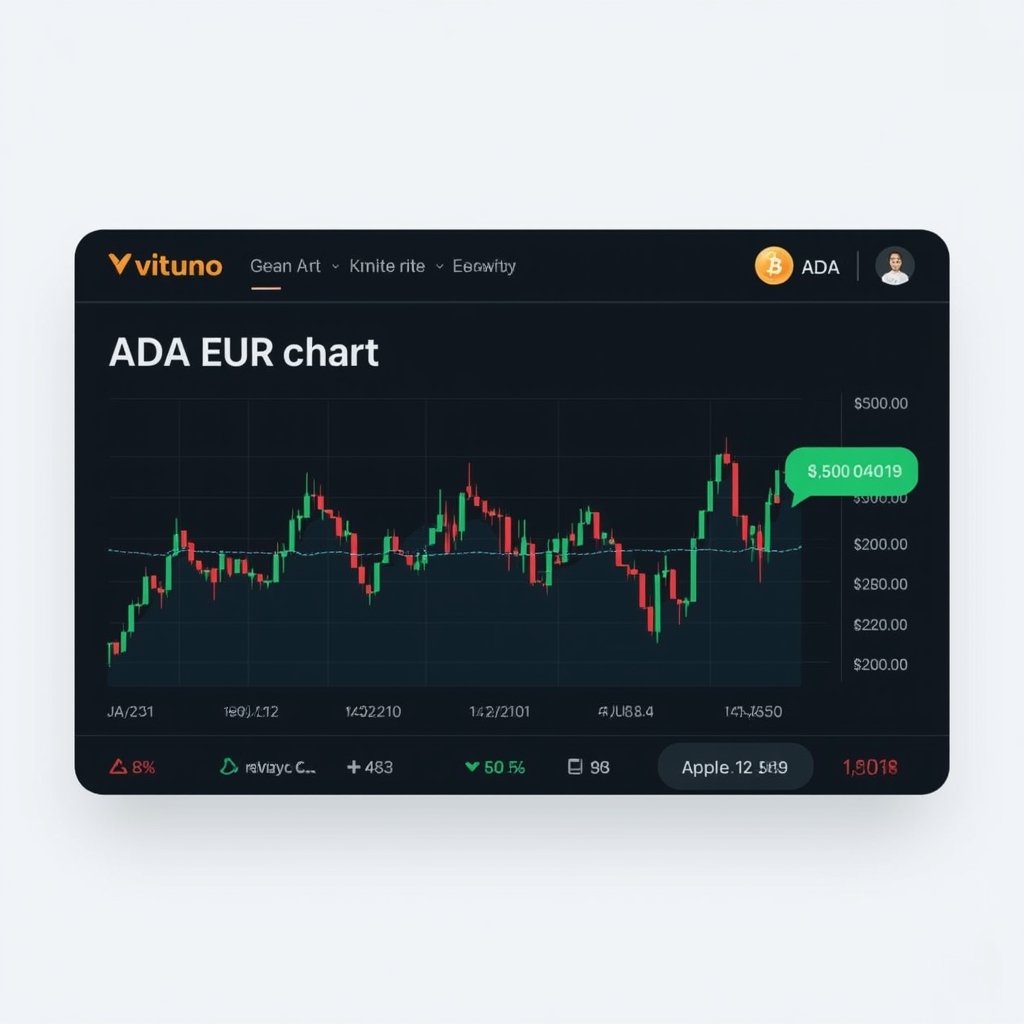
ADA/EUR price charts visualize the balance between buyers and sellers over time. Start with a higher timeframe (daily or weekly) to identify the primary trend and key support/resistance zones. Then drill down into 4H or 1H charts for entries and risk placement. Moving averages (50/200) help map trend bias, while horizontal levels around previous swing highs and lows often anchor liquidity and stop clusters.
Momentum tools like RSI and MACD can enhance ADA/EUR timing. For instance, a bullish divergence on RSI near a long-term support in euros can signal exhaustion of sellers, particularly if volume picks up during European trading hours. Conversely, overbought RSI combined with a bearish MACD cross near resistance suggests caution or profit-taking.
Candlestick patterns matter most at meaningful levels: rejections (long wicks) near resistance or engulfing candles after a range breakdown can front-run larger moves. Pay attention to gaps or sharp wicks that occur during low-liquidity windows—they can distort signals. Always confirm with volume and the order book depth on your ADA/EUR venue.
Key Drivers That Move ADA/EUR
Two forces meet in ADA/EUR: Cardano fundamentals and euro-area macro. On the crypto side, network upgrades (e.g., scalability improvements, governance milestones), staking participation, DeFi total value locked (TVL), and developer activity shape sentiment and long-run valuation. Partnerships, real-world asset tokenization pilots, or large treasury decisions can add momentum.
On the fiat side, the euro reacts to ECB interest rates, inflation data, industrial output, and labor conditions. A stronger euro (rising EURUSD) can mechanically push ADA/EUR lower if ADA’s USD price is flat, since each euro buys more dollars—and indirectly, more ADA at the same USD price. Conversely, euro weakness can buoy ADA/EUR even without crypto-specific tailwinds.
Liquidity cycles also matter. During European mornings, market makers and institutional flows often tighten ADA/EUR spreads. Around major events—ECB meetings, CPI prints, or Cardano upgrade news—volatility can spike. Correlations to BTC and ETH tend to rise during risk-off episodes, so broader crypto sentiment still influences ADA/EUR. Monitor cross-asset cues: DXY, EURUSD, sovereign yields, and crypto dominance indices.
Fees, Spreads, and Liquidity on ADA/EUR
Your net result on ADA/EUR hinges on all-in costs: maker/taker fees, spreads, funding (if using derivatives), and fiat on/off-ramp charges. Different exchanges quote ADA/EUR with varying depth and fee tiers based on volume and maker/taker roles. For frequent traders, maker rebates and tier upgrades can outweigh minor spread differences. For buy-and-hold, deposit/withdrawal fees and SEPA speed may dominate.
| Exchange (ADA/EUR) | Typical Maker/Taker | Spread (Active Hours) | SEPA Support | Notes |
|---|---|---|---|---|
| Exchange A | 0.10% / 0.20% | Tight | Yes | Deep EUR books; volume-based discounts |
| Exchange B | 0.16% / 0.26% | Medium | Yes | Strong mobile app; quick KYC |
| Exchange C | 0.00% / 0.30% | Tight–Medium | Yes | Zero maker fees; dynamic taker |
Note: Fee schedules change; confirm on the exchange website. In addition to spot markets, some platforms offer ADA/EUR perpetuals with euro margining—convenient for EUR-based PnL, but monitor funding rates.
| Pair | Base Currency Risk | Common Use Case | Considerations |
|---|---|---|---|
| ADA/EUR | EUR | EU-resident trading, SEPA DCA | Impacted by ECB policy and EUR data |
| ADA/USD | USD | Global liquidity benchmark | May require EUR↔USD conversions |
Trading Strategies for ADA/EUR
ADA/EUR strategies range from passive accumulation to active trading. For long-term investors, euro-based DCA smooths entry prices and aligns with salary cycles. Swing traders look for range breaks or mean-reversion between well-defined support/resistance. Day traders can exploit European session liquidity and news catalysts, combining momentum indicators with order book signals.
Range-bound conditions are common in crypto. Consider fading extremes when ADA/EUR pierces prior highs/lows without confirmation on volume or momentum. Conversely, trend-followers may deploy moving average crossovers or pullback entries toward the 20–50 EMA with tight stops. Beware of overfitting to USD-based signals; always validate on ADA/EUR charts.
- DCA in EUR: Automate recurring buys to reduce timing risk.
- Swing Breakouts: Enter on close above resistance; place stops under structure.
- Mean Reversion: Fade spikes into liquidity pools; target mid-range.
- News-Driven: Trade around ECB/Cardano events with predefined risk.
Risk-first execution matters more than signal precision. Keep position sizes consistent and let EUR-based PnL guide adjustments.
Risk Management for ADA/EUR Volatility
Crypto volatility is feature, not bug. On ADA/EUR, place stops where your trade thesis is invalidated, not where you hope price will turn. A simple approach: define entry, invalidation level, and take-profit targets before placing an order. Position size follows from the distance to your stop and your max risk per trade.
Use limit orders on illiquid moments to avoid slippage. If using leverage on ADA/EUR derivatives, scale conservatively—euro-denominated margin can mask exposure when volatility expands. Diversify across timeframes: intraday trades should be small and independent of your long-term EUR-based holdings.
Store long-term ADA in hardware or reputable self-custody wallets, segregated from trading balances. Keep EUR cash buffers for fees and funding. Document your strategy in euros so performance attribution is clean. And remember: sitting out during chaotic macro or upgrade windows is a valid risk decision.
On-Chain and Macro Indicators to Watch
ADA/EUR prices respond to both blockchain health and European economics. On-chain, monitor daily active addresses, transaction throughput, staking participation, and developer metrics (e.g., commits, smart contract deployments). Rising DeFi TVL on Cardano and successful scaling or governance milestones can shift long-term demand for ADA.
Macro-wise, track ECB rate decisions, euro-area CPI, PMI surveys, and EURUSD trends. A hawkish ECB can support the euro, pressuring ADA/EUR if crypto is flat. Conversely, easing or weak data may lift ADA/EUR by weakening the euro. Cross-reference with crypto-wide risk sentiment: Bitcoin dominance, stablecoin flows, and funding rates can forewarn liquidity changes.
- Cardano Upgrades: Roadmap progress and mainnet improvements.
- EU Data Prints: CPI, GDP, unemployment impacting EUR strength.
- Market Structure: Open interest, funding, and order book imbalances.
- Correlations: BTC and ETH moves during EU trading hours.
How to Buy ADA with EUR: Step-by-Step
Getting exposure to ADA/EUR is straightforward for EU residents thanks to SEPA and local rails. Here’s a practical flow that emphasizes security and fees:
- Choose an Exchange: Pick a regulated platform that lists ADA/EUR, supports SEPA, and has transparent fees.
- Complete KYC: Submit ID and proof of address for compliance; this unlocks higher limits and fiat transfers.
- Secure Your Account: Enable 2FA, set withdrawal whitelists, and create strong, unique passwords.
- Deposit EUR: Use SEPA for low-cost transfers; verify reference codes to avoid delays.
- Place an Order: For immediate fills, use a market order; for price control, place a limit order on ADA/EUR.
- Review Fees: Check the trade confirmation for maker/taker and any conversion or funding costs.
- Transfer to Wallet: Move long-term ADA to a hardware or reputable software wallet; keep some on-exchange only if actively trading.
- Track and Rebalance: Monitor ADA/EUR performance in your portfolio tool; set DCA or alerts around key levels.
For recurring buys, many platforms let you automate EUR debits into ADA/EUR at set intervals. Monitor bank fees and exchange pricing to keep your effective cost per ADA low.
Taxes, Regulation, and Storage for ADA/EUR Traders
Europe’s regulatory landscape is evolving, with the Markets in Crypto-Assets (MiCA) framework aiming to standardize oversight and consumer protections. While rules vary by country, most EU jurisdictions treat crypto disposals (selling ADA for EUR or swapping ADA for another crypto) as taxable events. Keep meticulous EUR-denominated records for each ADA/EUR trade: date, size, price, fees, and proceeds.
Common tax considerations include capital gains on profitable disposals, potential treatment of staking rewards as income, and reporting thresholds. Consult a local tax professional for precise guidance; software that supports EUR cost basis and ADA/EUR pair tracking can simplify filings. Many exchanges now offer downloadable statements in EUR to assist with compliance.
On custody, apply a layered approach. For active ADA/EUR trading, maintain minimal balances on the exchange. For holdings, use hardware wallets or audited custodians, enable multisig if available, and store recovery phrases securely offline. Regularly test small withdrawals to ensure you can access funds when needed. Finally, verify that your chosen exchange complies with KYC/AML standards and offers SEPA support with predictable settlement times.
Security hygiene complements your trading edge. Even the best ADA/EUR strategy falters if account access or private keys are compromised. Prioritize operational safety as much as technical analysis and macro awareness.
FAQ
What does ADA/EUR mean in crypto trading?
ADA/EUR is the trading pair that quotes the price of Cardano’s native token (ADA) in euros (EUR), showing how many euros one ADA is worth on a given exchange.
How is the ADA/EUR exchange rate determined?
The ADA/EUR price is set by supply and demand on each exchange’s order book, influenced by global ADA liquidity, euro FX conditions, market sentiment, and arbitrage across platforms.
Where can I trade the ADA/EUR pair?
You can trade ADA/EUR on major centralized exchanges that support euro markets, on regulated European brokers offering crypto, and via some fintech apps with fiat on-ramps.
What fees apply when buying ADA with euros?
Expect trading fees (maker/taker), a fiat deposit/withdrawal fee (e.g., SEPA, card), and a spread between bid and ask; some platforms also charge conversion fees if your account currency differs.
What is the spread on ADA/EUR and why does it matter?
The spread is the difference between the best bid and ask; tighter spreads mean lower implicit costs and usually indicate deeper liquidity in the ADA/EUR order book.
How can I reduce slippage on ADA/EUR orders?
Use limit orders, trade during peak liquidity hours, split large orders, and choose exchanges with deep ADA/EUR books to avoid moving the price.
What are common EUR funding methods for ADA purchases?
SEPA transfers typically have low fees but are slower; cards and instant banking are faster but costlier; some services support Apple Pay/Google Pay with higher fees.
How do I store ADA after converting euros to Cardano?
Withdraw to a non-custodial Cardano wallet (e.g., Lace, Eternl, Nami, Yoroi, hardware wallets) for control of keys, or keep it on an exchange wallet for convenience with added counterparty risk.
Can I stake ADA after buying with euros?
Yes, ADA can be delegated from a compatible wallet to a stake pool to earn rewards; staking is non-custodial and you keep control of your ADA.
Is ADA/EUR a volatile pair?
Yes, crypto volatility applies; ADA can swing significantly against the euro intraday and across cycles, so risk management and position sizing are important.
What is euro-cost averaging for ADA/EUR?
Euro-cost averaging is buying fixed euro amounts of ADA on a schedule, smoothing entry price over time and reducing timing risk in a volatile market.
What trading order types are useful on ADA/EUR?
Use market orders for speed, limit orders for price control, stop-loss to cap downside, and take-profit to lock gains; advanced users may use OCO where available.
Are there KYC/AML requirements to trade ADA/EUR in Europe?
Most regulated platforms require identity verification and AML checks before enabling EUR deposits and ADA/EUR trading, especially for higher limits.
How are ADA/EUR trades taxed in the EU?
Generally, selling or swapping ADA triggers capital gains/losses and staking rewards may be taxable income; rules vary by country—keep records and consult a tax professional.
What affects ADA’s price specifically against the euro?
Cardano network developments, crypto-wide cycles, eurozone interest rates, ECB policy, EUR/USD moves, and regional regulation all influence the ADA/EUR exchange rate.
Can I buy ADA/EUR instantly?
Many platforms offer instant buy with cards or instant banking; you pay higher fees and spreads compared to placing a limit order on the ADA/EUR spot market.
How can I check ADA/EUR historical performance?
Use exchange charts or aggregators to view ADA/EUR price history, volume, and indicators on multiple timeframes for technical analysis.
Is ADA/EUR available 24/7?
Yes, crypto markets trade around the clock; fiat deposits/withdrawals via banks may be limited to business days, but ADA/EUR order books remain open.
What are typical minimums for ADA/EUR trades?
Minimums vary by platform, often a few euros or a small ADA amount; check your exchange’s tick size and minimum order value.
What mistakes should I avoid when trading ADA/EUR?
Avoid overusing market orders in thin books, ignoring fees and spreads, leaving large balances on exchanges without security measures, and trading without a plan.
How does ADA/EUR differ from ADA/USD?
ADA/EUR reflects euro-based liquidity and EUR-specific FX dynamics, while ADA/USD often has deeper global liquidity; EUR-based traders avoid FX conversion by using ADA/EUR.
How does ADA/EUR compare to BTC/EUR for volatility and liquidity?
BTC/EUR typically has tighter spreads and deeper liquidity with lower relative volatility; ADA/EUR can be more volatile and may have wider spreads on smaller venues.
Is ADA/EUR or ETH/EUR better for euro-based traders?
It depends on goals: ETH/EUR usually offers deeper liquidity and different fundamentals, while ADA/EUR may present different risk/reward; compare fees, spreads, and project outlooks.
Should I trade ADA/EUR or ADA/USDT?
ADA/USDT often has very deep global liquidity and tighter spreads; ADA/EUR avoids stablecoin and FX conversion layers for euro users but may have thinner books on some exchanges.
What’s the difference between ADA/EUR and ADA/BTC pairs?
ADA/BTC prices ADA relative to bitcoin, useful for crypto-relative performance; ADA/EUR prices ADA in fiat euros, relevant for cashing in/out and tax accounting in EUR.
ADA/EUR vs ADA/GBP: which is more suitable in Europe?
Eurozone users benefit from ADA/EUR to avoid GBP conversion and extra fees; ADA/GBP may be preferable for UK users due to local funding and tax currency alignment.
How does ADA/EUR compare to the EUR/USD forex pair in risk?
EUR/USD is a major forex pair with comparatively low volatility and deep regulated markets; ADA/EUR carries higher crypto-specific volatility and different risk drivers.
What’s the difference between trading ADA/EUR spot and CFDs?
Spot ADA/EUR means owning ADA you can withdraw; CFDs are derivatives that mirror ADA/EUR price with leverage, financing costs, and counterparty risk, without on-chain withdrawal.
Centralized exchange ADA/EUR vs P2P euro purchases: which is better?
CEXs offer order book liquidity, transparent spreads, and faster execution; P2P may offer local payment methods and rates but adds counterparty and escrow considerations.
Is it cheaper to buy ADA with EUR directly or convert EUR to USD first?
Direct ADA/EUR usually avoids double conversion; converting EUR to USD adds FX fees and extra spreads unless USD rails are significantly cheaper on your platform.
Why do ADA/EUR spreads differ across exchanges?
Differences in user base, market makers, fee structures, and liquidity programs affect spreads; larger venues and peak hours typically deliver tighter ADA/EUR markets.
How do staking rewards relate to ADA/EUR performance?
Rewards are paid in ADA; your euro value depends on the ADA/EUR price at the time you sell, so fiat outcomes vary with market moves even if ADA quantity grows.
ADA/EUR vs buying ADA through a European ETP on a stock exchange: what’s the trade-off?
ETPs provide brokerage access and custody via an issuer with management fees and trading hours limits; spot ADA/EUR offers 24/7 trading and self-custody but requires crypto exchange use.
How does ADA/EUR compare to ADA paired with euro stablecoins?
Euro stablecoin pairs can mimic ADA/EUR without banking rails and settle faster on exchanges that support them; spreads and liquidity may differ from direct fiat ADA/EUR markets.